Industry news
Norway’s new Debt Collection Act: what businesses and accounting firms should prepare for in 2027
Norway’s new inkassoloven moves collection notices to licensed agencies. What changes for businesses and accountants before an expected 2027 start.
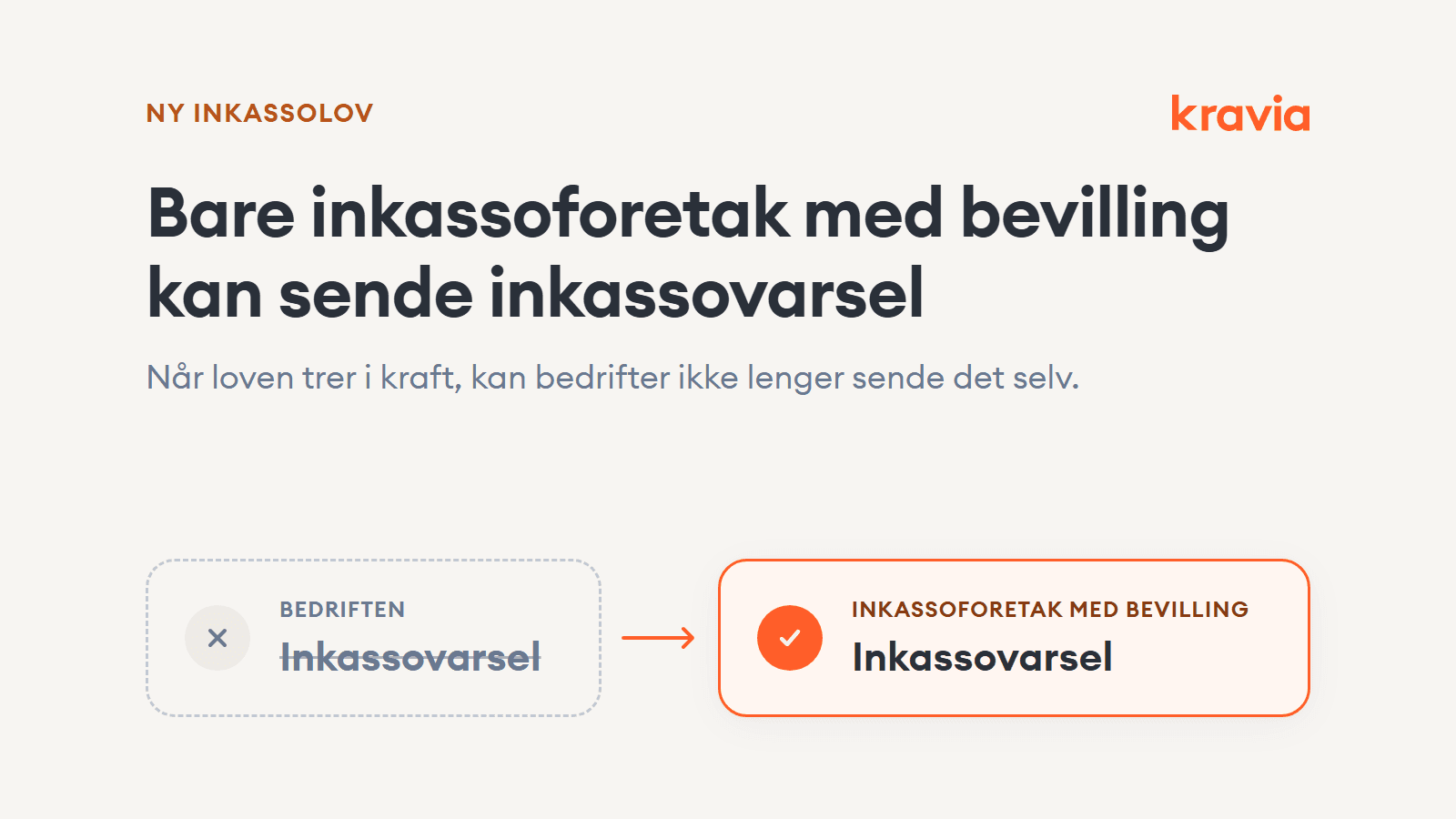
Norway’s new Debt Collection Act (inkassoloven) hands the formal collection notice, the inkassovarsel, to licensed collection agencies. Businesses and their accountants will still send ordinary payment reminders. What changes is the step that turns a reminder into a collection case: it moves out of the accounting system’s template folder and into the agency’s process.
The Act also tightens what debtors must be told, how disputed claims are handled and when collection costs can be charged. For accounting firms, most of the work sits in the handover between client, accounting system and collection partner. It starts with a licensing question: a firm that collects overdue claims for clients needs a licence of its own or a licensed partner.
Status as of 25 November 2026: adopted, not yet in force. The Act received royal assent on 22 May 2026 (Act No. 19 of 22 May 2026). Commencement will be set by the King, and the Act cannot take effect until a new inkassoforskrift has been adopted (Prop. 3 L (2025–2026), p. 361). As of 25 November 2026, no draft regulations have been published for consultation. The authorities have signalled 1 January 2027. Until commencement, the 1988 Act and its regulations still apply.
This article covers Norway only. Sweden, Finland and the Netherlands have their own collection rules.
In short
Only licensed collection agencies will send the collection notice (inkassovarsel) and the formal payment demand (betalingsoppfordring). Ordinary reminders stay with the creditor.
An accounting firm that collects overdue claims on behalf of clients needs a licence from Finanstilsynet, the Norwegian regulator. Where a reminder ends and collection begins depends on the set-up, so get it assessed.
Anyone collecting a claim, including a business collecting its own, must give the debtor detailed invoice information on request.
An objection that casts doubt on a claim stops collection while it’s investigated, and generally stops collection costs from being charged.
An agency collects several claims from the same creditor against the same debtor as one case once their notices expire.
New cost amounts will be set in regulations that haven’t been published. Don’t promise clients 2027 fee levels.
The new rules at a glance
The Act splits its rules in two. Some apply to everyone collecting an overdue claim, including businesses collecting their own. The rest apply only to licensed collection agencies. The table shows which is which, with the section number for anyone who wants to read the Act.
Rule | Section | Applies to | What to check |
|---|---|---|---|
Good collection practice, adapted to debtors in difficulty | § 14 | Everyone collecting | Escalation rules for vulnerable debtors |
Contact only 08–21 Mon–Fri and 09–15 Sat, never on Sundays, public holidays or official flag days, by phone, SMS or email | § 15 | Everyone collecting | When automated reminders and SMS go out |
Detailed invoice information on request | § 16 | Everyone collecting | Invoice data that reaches the collection step |
Reply to debtor enquiries within one week | § 17 | Everyone collecting | Who answers client queries, and how fast |
Recovery of collection costs | §§ 18–19 | Everyone collecting | Objection handling and rule breaches |
Collection notice (inkassovarsel) and payment demand (betalingsoppfordring) | §§ 20–21 | Collection agencies | Which client messages are formal notices |
Joint collection of several claims | § 22 | Collection agencies | Claims with the same creditor and debtor |
Stop collection when a claim is in doubt | § 24 | Collection agencies | Who supplies evidence |
Objections and complaints procedure | § 25 | Collection agencies | Dispute routes |
Written assignment agreement | § 31 | Collection agencies and their creditor clients | Client agreements |
Who sends the formal collection notice?
Under the new Act, the collection agency sends the inkassovarsel. If its deadline passes unpaid, the agency sends the betalingsoppfordring. Finance Norway puts it more bluntly: creditors can no longer send collection notices themselves, and must use an agency for both steps.
Today, many businesses print an inkassovarsel straight from their accounting system. That route closes when the Act takes effect, but not before; until commencement the 1988 rules apply and those notices remain valid. An ordinary payment reminder (purring) stays the creditor’s to send under both regimes.
So the job is sorting every template and automated rule into one of two buckets: reminder, or formal collection step. Renaming a template won’t do it. The rule that triggers the message, and the data inside it, have to change as well.
What it means for businesses collecting their own invoices
Own-account recovery (egeninkasso) stays legal. The Act defines it, and the government’s stated aim was simpler, lighter duties for creditors than for agencies. What goes is one tool: the inkassovarsel printed from your own accounting system.
What you can still do yourself:
Send payment reminders (purringer) in your own name.
Send a fee-bearing demand letter of your own, once the regulations define one. The Act lets the regulations set the form, content and timing of fee-bearing letters, with separate rules for own-account collection. Their names and fees aren’t public yet.
Take a claim to the enforcement officer (namsmannen) yourself, after sending the notice the law requires before enforcement. The new Act doesn’t change that rule.
Does an accounting firm need a licence to collect for its clients?
Only with a licence, if the firm collects overdue claims for clients as part of its business or on a regular basis. The Act calls that fremmedinkassovirksomhet, and it needs a licence from Finanstilsynet, the Norwegian regulator (§§ 5–6). Only a licensed agency can send the inkassovarsel and betalingsoppfordring, so a firm without a licence can’t send them for a client. Reminders are less clear-cut. It depends on who the firm sends them for, in whose name and how often. A standing reminder service for many clients is closer to the line than a reminder the client sends in its own name. Get your set-up assessed before the Act takes effect.
What else changes for accounting firms and their clients?
Debtors can ask for the full story behind an invoice
Anyone collecting a claim, a business collecting its own included, must on request tell the debtor: the creditor’s name, case and invoice number, invoice date, what was supplied and when, the principal, how interest was calculated, costs so far, payments made and what’s left to pay. Agencies must also print most of this in the inkassovarsel and betalingsoppfordring, together with estimated collection costs and short guidance on payment difficulties, objections and complaints. The notice must give at least 14 days to pay.
An invoice number on its own won’t answer any of that. Check what your accounting system passes downstream: the description of goods or services, the delivery date, credit notes and part-payments.
An objection pauses collection, and usually the costs
When an objection or anything else casts doubt on a claim, the agency must stop collecting while it investigates. If the creditor doesn’t answer questions about the claim within a reasonable time, the agency must drop the case. Stopping doesn’t cancel the debt.
The cost rules raise the stakes. Collection costs generally can’t be charged while the debtor has an objection on the table, unless it’s obviously groundless or came later than it should have. Handling objections can never be charged for. Costs also fall away if the claim turns out to be wrongful, or if whoever is collecting broke the rules against that debtor. A client who takes weeks to find a contract can lose the case and the costs.
If an objection isn’t resolved and the creditor still wants payment, the dispute goes to court, unless the debtor withdraws it or takes it to an approved complaints body within a reasonable time. Agree now who supplies contracts, invoice copies and credit-note history, and how fast.
Reply times need an owner
Anyone collecting a claim must answer debtor enquiries as soon as possible and within one week. When an enquiry needs investigating, send an interim reply within that week saying why, when to expect an answer and what happens to payment deadlines meanwhile. Decide which enquiries your firm answers, which go to the client and which go to the agency.
Several claims become one case
An agency must collect several claims with the same creditor and the same debtor together. Each claim still gets its own inkassovarsel; once those deadlines pass, the agency sends one joint betalingsoppfordring. There are exceptions, for example when the debtor asks for separate handling or when consumer and business claims are mixed.
The agency agreement must be in writing
The agreement between a creditor and its collection agency must be in writing. It has to cover how long it runs, the collection steps, the agency’s fee, its authority, how wrongful claims are stopped and how the creditor is kept informed. The creditor can’t ask the agency to go harder than the agreement allows. If the creditor keeps sending wrongful claims, the agency can end the agreement. Your clients’ data quality now has contractual consequences.
Fees wait for the regulations
The new cost amounts will be set in regulations, with separate rules for businesses collecting their own claims and for agencies. Today’s figures, including the 2026 inkassosats of NOK 750, come from the 1988 regulations. Don’t build workflows or client promises around assumed 2027 fee levels.
A preparation checklist for accounting firms
Download the checklist as a PDF (in Norwegian)
These are recommended steps, not legal duties placed on every accounting firm.
Map who sends what for each client: reminders, the formal notice, the payment demand and later steps.
Sort templates and automated rules into reminders and formal collection steps. Switch off creditor-sent inkassovarsel templates when the Act takes effect, not before.
Check that automated reminders and SMS go out only within the § 15 contact hours: 08–21 Monday to Friday and 09–15 on Saturdays.
Check that the invoice data reaching the collection step covers what the debtor is entitled to know.
Test how payments, part-payments, credit notes and objections travel from the accounting system to the collection partner, and back.
Name who answers debtor enquiries and evidence requests, and how quickly.
Review client agreements with collection agencies against the written-agreement rules.
Have your own reminder service for clients assessed against the licensing rules.
Watch Lovdata for the commencement decision, transitional rules and the new regulations.
How Kravia fits
In Norway, Kravia AS is a licensed debt collection agency supervised by Finanstilsynet. Under the new process, Kravia sends the inkassovarsel and betalingsoppfordring for claims handed over to it. Reminders and the handover run from the accounting system your clients already use, through integrations with more than 50 accounting and ERP systems, with one overview of every client’s unpaid invoices.
Talk to Kravia about collection for your accounting firm
Collecting your own invoices? See Kravia for businesses.
Frequently asked questions
When does Norway’s new Debt Collection Act take effect?
The date isn’t set. The Act can’t take effect until new regulations are adopted, and none had been published for consultation as of 25 November 2026. The authorities have signalled 1 January 2027, and individual provisions can start at different times. Treat 1 January 2027 as expected, not confirmed.
Can a business still send its own inkassovarsel?
Until the Act takes effect, yes; the 1988 rules apply. After that, the inkassovarsel and betalingsoppfordring come from a licensed collection agency. Ordinary payment reminders stay with the business under both regimes, and the new regulations can define a fee-bearing letter for own-account collection.
Is own-account debt recovery (egeninkasso) banned?
No. The Act defines it and keeps it. Businesses collecting their own claims follow the rules that apply to everyone collecting, including the duty to give invoice information on request.
Can an accounting firm collect debts for its clients?
Yes, with a licence. Collecting for others as part of a business or on a regular basis needs one from Finanstilsynet in Norway, and only a licensed agency can send the inkassovarsel and betalingsoppfordring. Whether a reminder service run by the firm falls inside that needs a specific assessment.
Must claims from different clients against the same debtor be pooled?
No. The duty covers claims with the same creditor and the same debtor, with exceptions. Each claim gets its own inkassovarsel first.
Does a disputed claim have to be deleted?
No. Collection stops while the doubt is investigated. The debt itself stands until it’s paid, withdrawn or decided otherwise.
Do the rules apply to business-to-business claims?
Yes. The notice, payment demand and joint-collection rules can be varied by agreement between creditor and debtor, but never to a consumer’s detriment.
What will collection fees be under the new Act?
Not yet known. The amounts will be set in regulations, with separate rules for businesses collecting their own claims and for agencies.
Does the reform apply across the Nordics?
No. It’s a Norwegian law. Firms with clients in Sweden, Finland or elsewhere should check each country’s rules separately.
This article is general information, not legal advice. The provisions described apply from commencement, subject to transitional rules. Last checked: 25 November 2026.